Interactive projector for care homes, senior living and memory care
The Kmoove interactive projector turns the care home activity room, including memory care and dementia units, into a shared space for movement, accessible to residents in a wheelchair, in bed or standing. A power outlet is enough, and no IT skills are required.
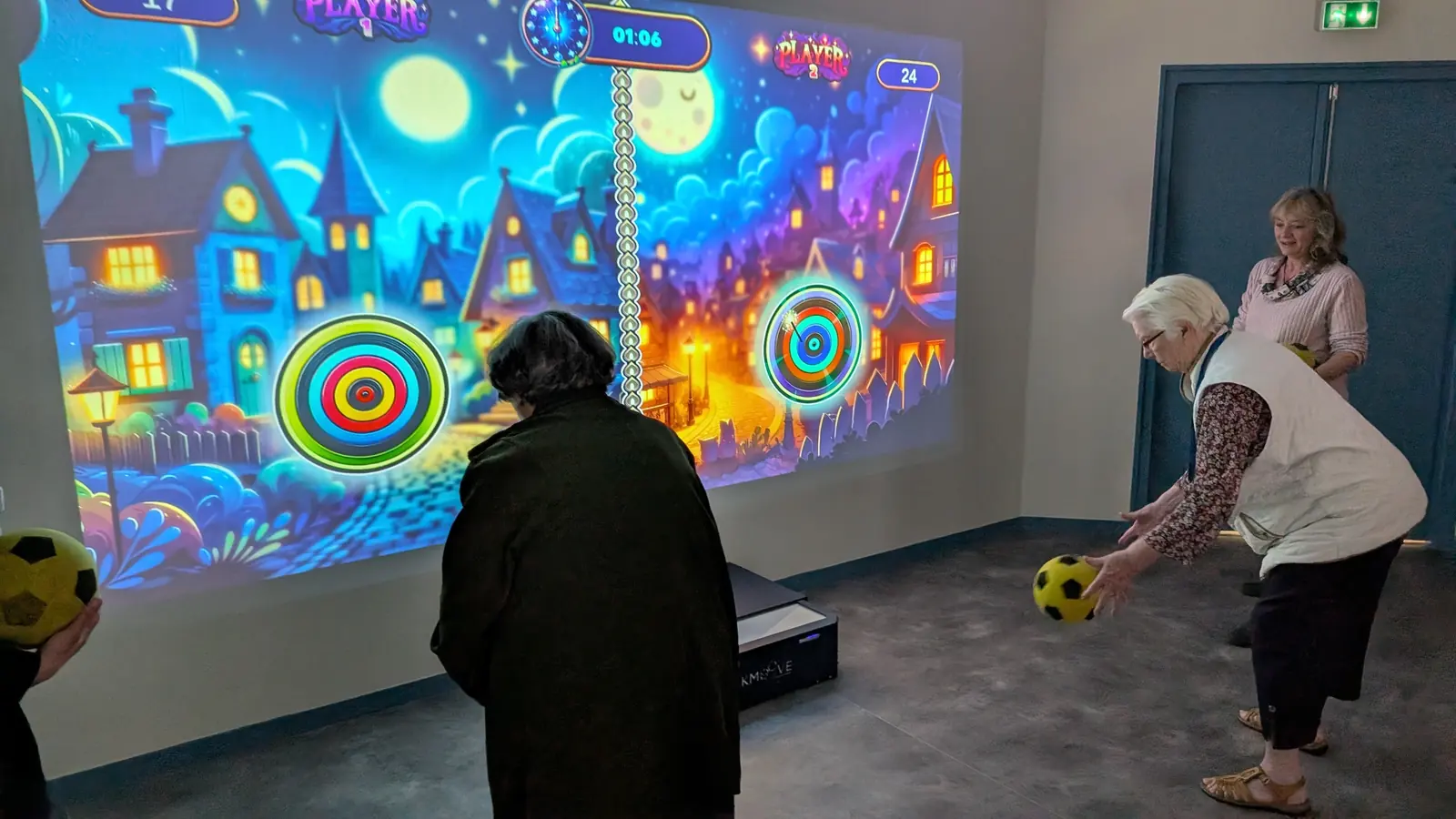
The interactive wall brings movement into daily group activities. Residents play standing, seated or in a wheelchair, alone, five at a time or sixteen in relay, with no controller and no individual screen. Activity staff launch a session in seconds and adjust the difficulty to each resident's profile.
- 50
- Available apps
- 5
- Game universes
- 15
- Customizable activities
- 5 / 16
- Players at once, in relay
What it changes day to day
Adapted physical activity
Full accessibility
Varied programming
Ready in seconds
How teams use the wall
- Morning or afternoon group activities
- Adapted physical activity sessions led by an occupational therapist or a motor skills specialist
- Quiet time with calming content and heart coherence exercises
- Fine and gross motor workshops adapted to each resident's pace
- Secure units: simple-instruction games, with no excessive stimulation
Real deployments
In nursing homes, the interactive wall rarely replaces an activity: it brings in new ones, with residents who had stopped taking part.
Bringing residents back to the morning activity
80-bed nursing home, two-person activity team
The morning workshops always drew the same residents. Those in wheelchairs stayed spectators, for lack of a truly accessible group activity.
A K-Station fixed in the activity room, using the existing projector, with a daily twenty-minute session built by the activity coordinator.
- Residents standing, seated and in wheelchairs in the same session
- Memory workshops personalized with photos of the local town
- Sessions restarted in ten seconds by a substitute staff member
Structuring adapted physical activity sessions
Senior living residence with a part-time occupational therapist
Balance and weight-transfer exercises felt repetitive to residents, with a high drop-out rate during the program.
A three-stage routine: warm-up with a throwing game, effort with a precision game, wind-down with a heart coherence exercise.
- A consistent format from one session to the next, easier to follow
- Durations and scores visible on screen, reusable in progress reports
- Participation maintained throughout the whole program
It gets us moving: we were sitting down a bit too much. It's very playful. We also took part in an intergenerational activity, and being with younger people makes us feel younger.
These are really engaging games. You can play with several people, it's great fun: time flies.
Questions we hear from teams like yours
- Does the interactive wall work for residents in a wheelchair or bedridden?
- Yes. The playing surface adjusts in height and target size, so residents can play seated, in a wheelchair, in bed or standing, all in the same session. Residents with limited mobility can join with a simple arm gesture.
- Which staff member can run sessions in a nursing home?
- Activity coordinators, occupational therapists, motor skills specialists, adapted physical activity instructors or care staff: getting started takes a few minutes. A session launches in ten seconds, with no IT skills required.
- Can it be used in secure or memory care units?
- Yes. Simple-instruction games, heart coherence exercises and calming content suit fragile profiles. Difficulty and speed are adjusted resident by resident.
- Can a facility fund an interactive wall through an activity budget or a grant?
- Facilities often draw on activity budgets, healthy ageing and fall prevention funding, or dedicated foundations. No mandatory subscription adds to the file.
- How much does an interactive wall cost for a nursing home?
- The Kmoove interactive wall starts from €5,990 excluding VAT for the K-Station S, including a 3-year warranty. The final price depends on the configuration chosen (fixed or mobile, projector, K-motion camera option, content packs): it is provided on request in a detailed quote.
- What is the difference with a tabletop projection system?
- A tabletop system projects an image onto a table or the floor, around which a few residents gather, mainly for gentle stimulation. The Kmoove interactive wall projects a 2 to 4 meter image onto a wall: residents stand up, throw, and move around, with up to five simultaneous players, sixteen in relay, and unlimited touch points. It covers cognitive activities as well as adapted physical activity, and Editor mode lets you build your own content.
- Does the interactive wall help with fall prevention?
- It is used in balance, coordination and weight-transfer workshops led by an adapted physical activity instructor, a physiotherapist or a motor skills specialist. It is not a medical device: it is an activity and adapted physical activity tool that makes these exercises more engaging and more regular.
- Do we need a projector?
- Yes for the K-Station, which works with your existing projector or can be ordered as a pack with an ultra short throw projector, recommended to avoid players casting shadows. The K-Mobile already has its projector built in: just place it and plug it in.
- How many residents can join a session?
- In practice, teams run groups of six to twelve residents: up to five active players on the surface, sixteen in relay, cheering or team roles. The wall stays visible to the whole group, unlike an individual screen.
Tell us about your facility
Send us your room size, your audience and your timeline. We reply with a detailed quote within 48 hours.