
Disability and inclusion · September 9, 2026 · 6 min read
Sensory rooms and interactive walls: what each one is for
Teams often ask whether an interactive wall replaces a sensory room. It does not, and the two answer different needs. Here is what each is for, and how settings use both without duplicating.
What a sensory room does
A sensory room lowers arousal. Controlled light, texture, sound and slow movement give a person space to regulate, usually alone or with one adult. Nothing is asked of them, and that absence of demand is the active ingredient.
It is the right environment after a difficult moment, before a transition, or for a person who needs to withdraw from a busy setting.
What an interactive wall does instead
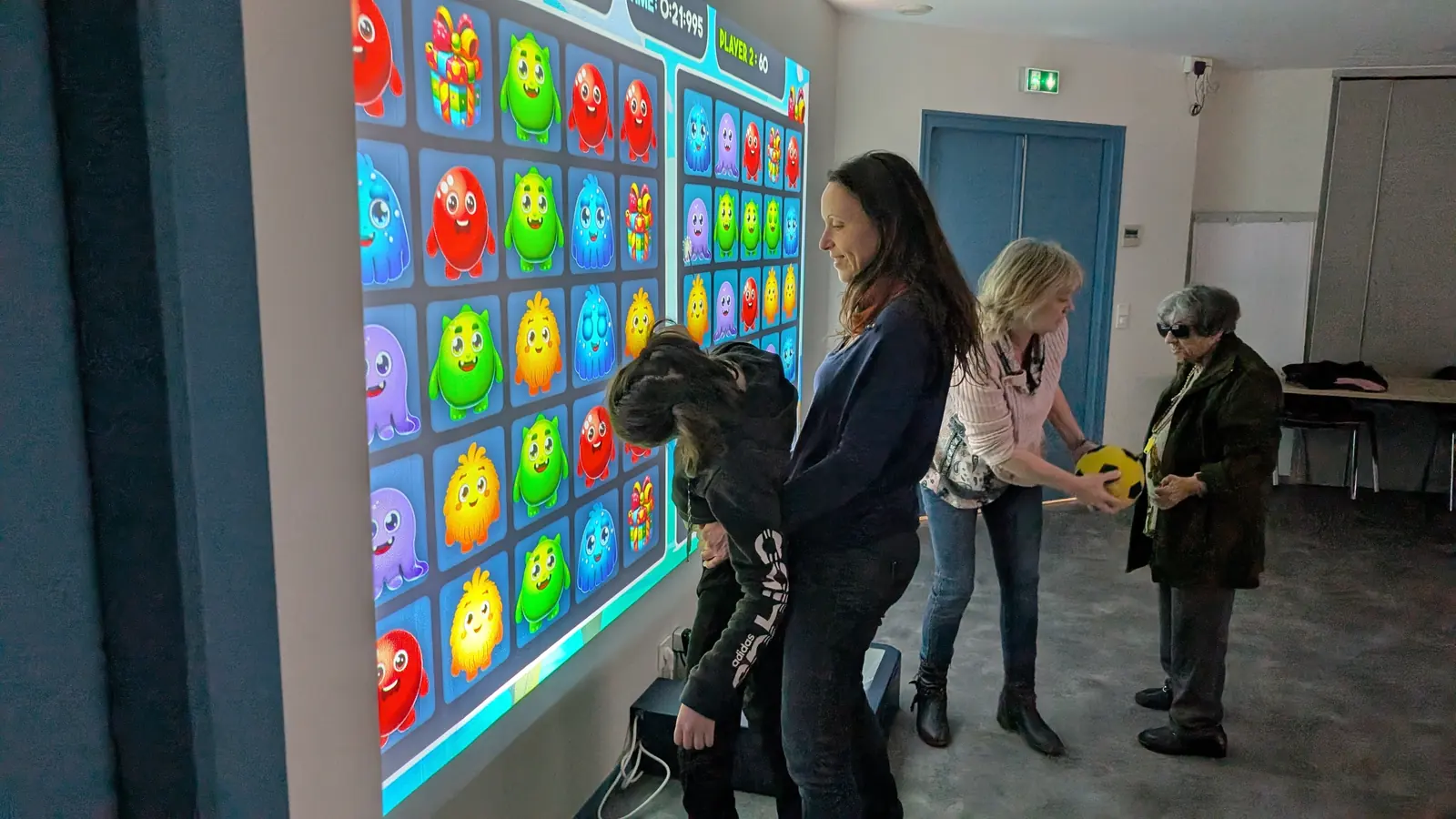
It raises engagement and shares attention. Several people look at the same image and act on it together. There is a demand, a response and an immediate result, which is the opposite of a sensory room's design.
That makes it useful at a different moment: when a person is available and the aim is participation, motor activity or joint attention rather than regulation.
Can the wall be used inside a sensory room?
Yes, and settings do it, but with the intensity turned down. Sound off or very low, simplified colors, slowed animations, one target at a time. Used that way it becomes a slow visual activity rather than a game.
The risk to avoid is turning a regulating space into a stimulating one. Where a room serves both purposes, most teams bring a K-Mobile in for a session and take it out again, which keeps the room's identity intact.
Does it overstimulate?
It can, like any screen, and that is why every setting is adjustable. Sound can be switched off entirely. Detection uses a laser sensor by default, which captures no image at all, so nothing is filmed.
Teams that start with the calmest settings and add stimulation gradually get further than teams that start at full intensity and retreat. Refusal is much harder to undo than a slow start.
What content works for non-verbal users?
Visual instructions rather than spoken ones: a color to hit, a shape to find, an image to match. Understanding does not depend on language, which is what allows a non-verbal person to join a group activity rather than watch it.
Editor mode lets a team build content with the pictograms already used in the setting, photographs of familiar places and the vocabulary of an individual plan. See the disability services and special education page for how settings structure this.
Which one should a setting buy first?
If the setting has neither, the answer depends on what is missing rather than on what is newer. A setting whose main difficulty is dysregulation, meltdowns and transitions needs a sensory room. A setting whose difficulty is participation, isolation and physical inactivity needs the wall.
Most settings that have both use them at opposite moments of the same day, and staff describe them as answering opposite needs rather than competing.
Does it need its own room?
No. A K-Mobile is rolled into a room, used for a session and taken out again, which suits a space that serves several purposes and protects the identity of a regulating room. A K-Station suits a room that can stay set up permanently.
The image is adjustable from two to four meters (roughly 7 to 13 feet) wide, so a small room is rarely the obstacle teams expect. Direct daylight on the projection area is the one real constraint, and a blind usually solves it.
What does it cost?
From €5,990 excluding VAT, with twenty activities built in that work for life with no subscription. The pricing page sets out what makes a quote vary, and we survey the room before quoting.
Related sectors
Featured models
Ready to see the interactive wall in your facility?
Request a quote and we will get back to you within 48 hours with configuration and pricing.