
Disability and inclusion · September 28, 2026 · 6 min read
Activities for autistic adults: movement that never feels childish
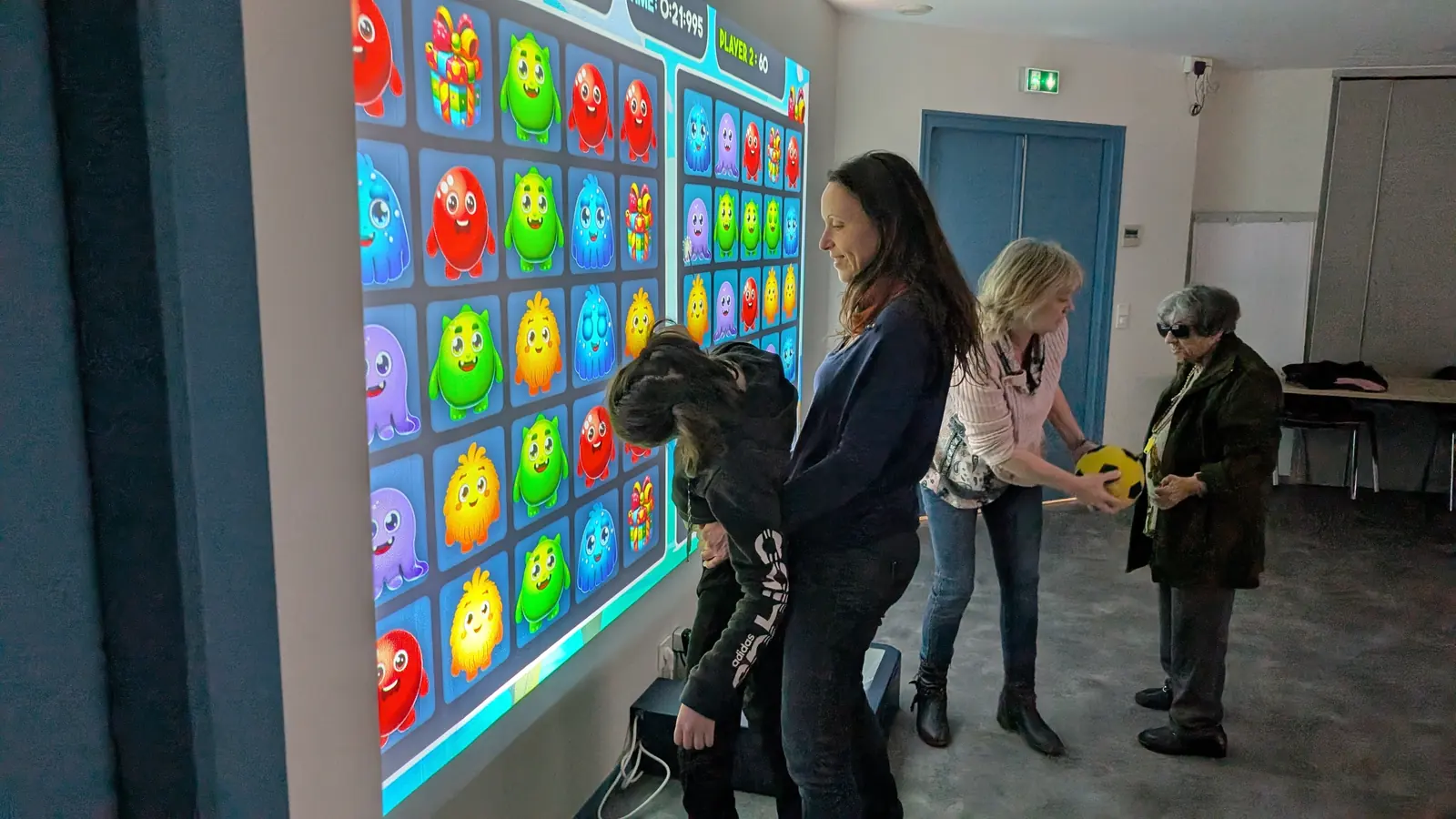
In adulthood, physical activity moves to a new setting: a group home, a residential program, a day program or a supported workplace. It has to stay accessible without looking like a children's game. Here is how teams do it with an interactive wall.
Why movement for autistic adults needs a different approach
Most autistic adults who receive support live in a residential program or a group home, attend a day program, or work in a supported employment setting. The groups are very mixed: ages spread over several decades, verbal and non-verbal participants, some who walk and some who use a wheelchair.
Yet a large share of movement and play equipment was designed for children, with cartoon characters, bright colors and cheerful voices. Offered to an adult, that look can feel demeaning, and a refusal to join in sometimes comes from there rather than from the difficulty of the task. The goal is to keep the activity simple to access while dropping the childish packaging.
If you work with children, two other articles cover that audience: motor activities for autistic children and adapting physical activity for autism and ADHD. This one is about adults.
Content that respects adult age
The Kmoove game library is not limited to childhood: the same games are used in senior living, in training programs and at corporate events. A team in an adult residential program can therefore pick skill, sorting or reaction games whose visual style suits adults.
With the E versions, Editor mode goes further: the images, words and questions in the games can be replaced with the person's own. Photos of the home and the neighborhood, tools from the workshop, the picture symbols the team already uses, each person's interests. A resident who loves trains finds trains in the sorting game, and the activity becomes theirs.
No IT skills are needed. Staff prepare the content on a computer outside of play time and find it on the wall at the next session. Activities published by other organizations can be reused too.
Sound, images, speed: setting the intensity for a sensitive adult
Everything is decided before the game starts. Sound can be switched off entirely, fewer elements appear on screen, the pace slows down and the targets get bigger. For a calming moment, content can run in soft colors, slowly, with no score.
Size is another lever: the projected image ranges from two to four meters wide. A small image focuses the gaze. A large one invites broad movements.
In the standard setup, the wall detects gestures with a laser sensor that does not film. No camera points at the person, which matters for anyone who dislikes being watched. The K-motion depth camera is an option only, for full-body games.
Six activities, from the calmest to the most active
Each activity is played with a hand, the body or soft balls, standing, seated or in a wheelchair. The order below is a gradual increase in intensity, adjusted to each person.
- Tapping large, slow targets: the target reacts to the gesture, so cause and effect make sense without spoken instructions.
- Playing a sorting game whose images are everyday photos prepared in Editor mode.
- Following a moving object with a finger, for visual attention and hand-eye coordination.
- Aiming at still targets with a soft ball, from a distance set by the staff member.
- Taking turns in a relay on the same game, with one shared score for the group.
- With the K-motion option, moving arms, legs and torso without throwing anything, for people who cannot hold a ball.
Fixed landmarks first, small changes later
Many autistic adults rely on fixed landmarks. A wall that stays mounted in the same room always offers the same place, the same way to start, the same opening activity. The session begins predictably, which lowers anxiety.
Once those landmarks are in place, staff add small novelties: one more target, a different background, a slightly faster pace. If the change is unsettling, going back to the familiar version is immediate.
Moving to group play follows the same logic. First alone at the wall, then two side by side, then a small group: up to five simultaneous players and sixteen in relay. The relay makes the playing order visible, so everyone knows who goes before them.
Who runs the sessions, and toward which goals?
Depending on the organization, sessions are led by direct support professionals, special educators, occupational or psychomotor therapists, adapted physical activity instructors or workshop supervisors. The goal of each session comes from the person's individual plan: keeping up regular physical activity, maintaining coordination, spatial orientation or turn taking.
Scores, durations and successes appear on screen and can be copied into progress notes. The system collects no personal data.
The wall is not a medical device. It adds to care and support without replacing them, in a playful form that many residents prefer to an exercise they are told to do.
Which equipment for a residential or day program?
For an activity room or a sensory room, the K-Station E is mounted on the wall and stays there, which gives the fixed landmarks described above. If the equipment has to move between buildings or between sites of the same organization, the K-Mobile E sets up in five minutes, with no tools and no drilling.
Either way, you need a light-colored wall and a power outlet, and the K-Mobile takes up about five square meters of floor space. No Wi-Fi connection is needed to play. Twenty games are built in for life, with no subscription, which makes funding applications simpler.
Our disability services page details how the wall is used in the sector, and our pricing page explains the options. We come back to you within 48 working hours.
Featured models
Ready to see the interactive wall in your facility?
Request a quote and we will get back to you within 48 hours with configuration and pricing.