Disability and inclusion · September 9, 2026 · 6 min read
Motor activities for autistic children, with no controller to hold
A controller adds a step between intention and result, and every step is a chance to fail at something unrelated to the activity. Here is what changes when the gesture is the only control.
Why the controller is the problem
A controller has to be held, oriented, pressed at the right moment and not dropped. For an autistic child, each of those is an opportunity to fail at something that has nothing to do with the activity itself.
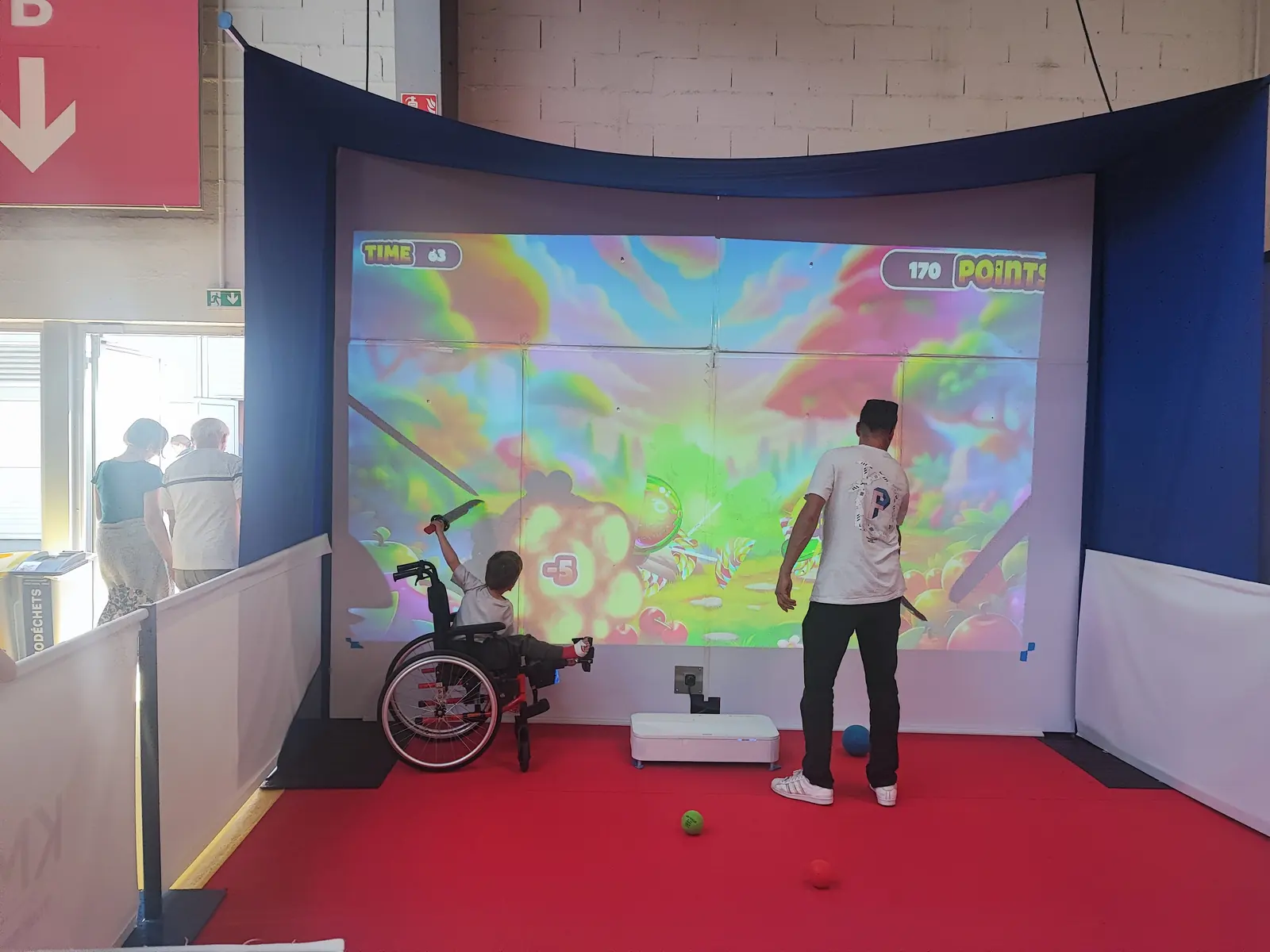
Remove the interface and those failures disappear. The child throws a soft ball or touches the target with a hand, and something happens immediately. The link between action and effect is direct, which is exactly what makes an activity readable.
Eight activities that work without one
Color matching, where the child hits the target that matches a shown color. Sequence following, touching targets in a given order. Odd one out, finding the image that does not belong. Cooperative targets, where two children must act together.
Then: throwing at a moving target for tracking, mirrored movement where the child copies a shape, sorting by category, and simple counting games where the answer is given by hitting the right number.
All eight work standing or seated, alone or in a group of up to five at once with sixteen taking turns.
How do you start with a child who refuses activities?
One very simple game, two or three minutes, alone or with one other child. What matters at that stage is not the score but whether the child returns to the wall unprompted. That first voluntary return is the signal that the activity has been understood.
Keep rounds short and stop while engagement is still high. Difficult endings are what make a child refuse the following session.
Can sensory intensity be reduced?
Sound can be lowered or switched off, colors simplified, animations slowed and targets enlarged. Detection is by laser sensor as standard, which captures no image, so nothing is filmed.
There is also no individual screen, which means an adult can see at a glance what a child is doing and intervene with a word rather than by taking a device away.
Can we build activities around one child?
That is what Editor mode is for. A team builds content on an office computer and syncs it to the wall: photographs of the setting, the pictograms used in class, the vocabulary of an individual plan, images of places the child walks through every day.
A matching game built with the faces of the support team produces engagement no off-the-shelf content reaches. It takes an afternoon to build, and it belongs to the setting.
Kmoove records no health data. The system is an activity tool, not a medical device, and it replaces no professional assessment. See the disability services page and the frequently asked questions.
Does it work in a classroom, or does it need a separate room?
Both. A K-Mobile is brought into a classroom for a session and taken out again, which suits a school where no room can be dedicated. A K-Station stays installed in a therapy or motor skills room.
No network is needed in either case, which matters in schools where opening a network access point takes a term. An outlet is enough.
How many children can take part at once?
Five at the same time, sixteen taking turns in the same game, with no limit on the number of impacts detected simultaneously. For a small group in a special education setting, that means the whole group is in the activity rather than queueing for it.
Children who cannot throw or reach the wall take part through the optional K-motion camera, which detects body movement without a ball or any object.
What does it cost?
From €5,990 excluding VAT. The E version, which includes Editor mode and the full catalog, is the one most special education settings choose, because building content around a specific child is the feature that changes outcomes. The pricing page lists the six configurations.
Related sectors
Featured models
Ready to see the interactive wall in your facility?
Request a quote and we will get back to you within 48 hours with configuration and pricing.