
Healthcare and disability services · September 9, 2026 · 8 min read
Cognitive games for seniors: working the mind while the body moves
Cognitive activities in senior living almost always happen seated, at a table, on paper. Residents lose attention and the body does nothing. Here is how communities work memory and language while residents stay on their feet.
What a cognitive game is, and what movement adds
A cognitive activity works memory, attention, language, numbers, spatial orientation and the ability to plan an action. In senior living it usually takes the form of a quiz, a bingo card, words to find or images to match, around a table with the group seated in a circle.
That format works, and it has two limits every activities director knows. After twenty minutes seated, part of the group disengages. And the body does nothing at all, while sitting is one of the fastest routes to losing independence.
Doing the same exercise standing changes the mechanics. The resident finds the answer, then has to move and aim to give it. Mental effort and physical effort support each other instead of competing.
The real difficulty: the group is never uniform
In one room an activities director has independent residents who disengage if it is too easy, wheelchair users who cannot reach anything mounted high, disoriented residents who lose the thread of a long instruction, and sometimes one or two people who no longer speak.
A paper activity forces a choice of level, which means leaving part of the group out. That is why cognitive programs so often shrink to the same six or seven residents.
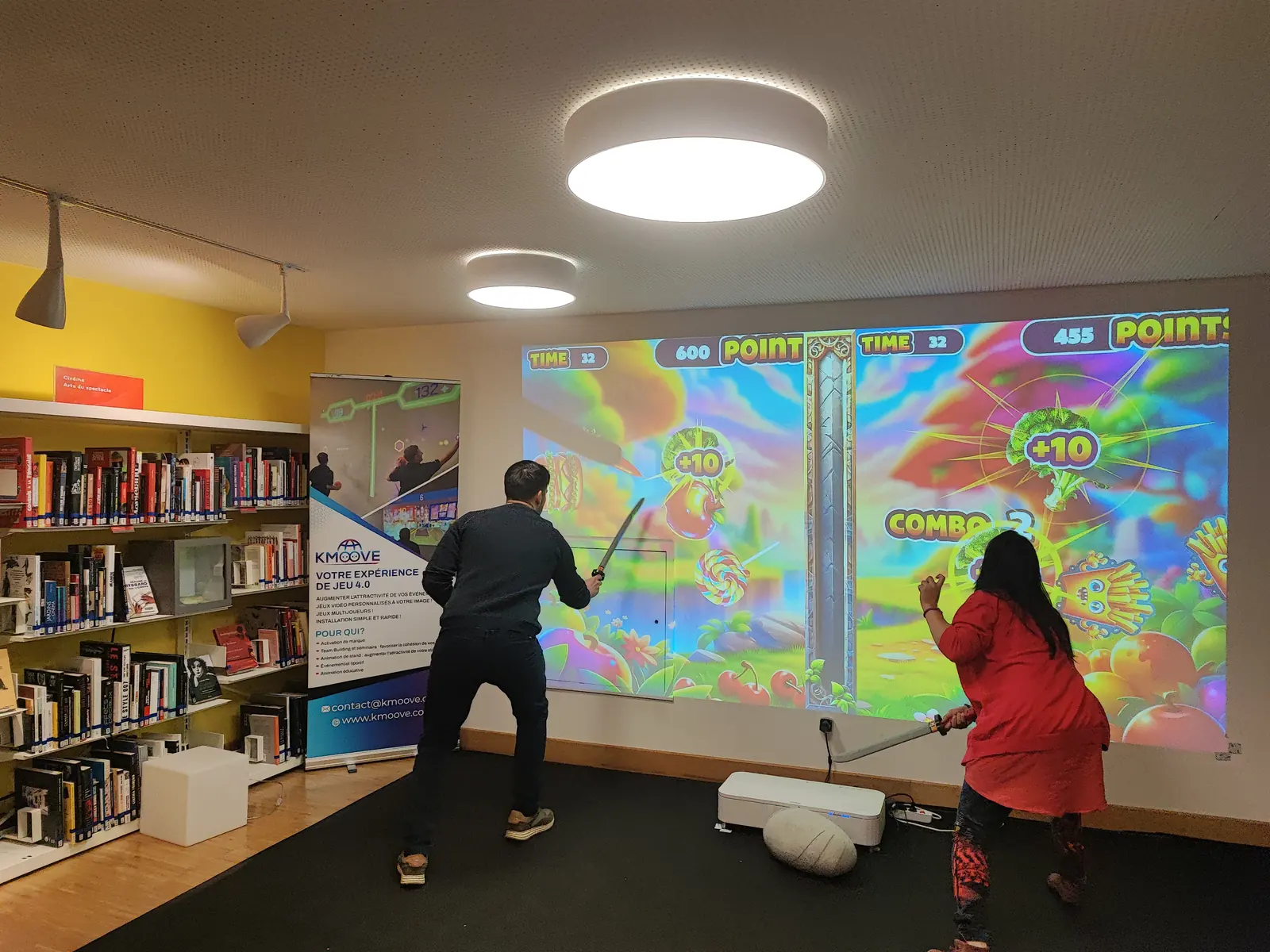
On a wall, the level changes without anyone noticing. Target size, speed, round length and the number of options are adjusted in seconds between rounds. A seated resident plays the lower part of the image and a standing resident the upper part, in the same game.
- Larger targets for residents with low vision or tremor
- Lower area of the image reserved for seated players
- One instruction at a time, kept short
- Rounds of two to three minutes, matched to attention span
Which cognitive activities work standing up?
Visual memory. Pairs to find, images that appear and disappear. The resident memorizes, moves, points. The difference from a table game is the movement, which anchors the memory in a gesture.
Language. Letters to assemble, words to complete, categories to sort. These make the group talk as much as move: residents help each other out loud, which paper activities rarely produce.
Numbers. Simple operations, sequences, totals to reach. This family works best with residents who kept strong school reflexes, and it returns an immediate sense of competence.
Attention and orientation. Targets to touch in order, odd ones out to find, colors to follow. These train sustained attention and the ability not to respond to the wrong signal.
How many residents, and how does a session run?
Five residents play at the same time and sixteen take part by taking turns. The number of impacts detected at once is not limited, so two residents can play side by side on the same area without the system losing track.
A session runs in three parts: five minutes to settle the group with something very simple, twenty to twenty-five minutes of activity with a change of game every two or three rounds, then five quiet minutes before residents return to their rooms.
What does it ask of the staff?
Very little, which is what decides whether equipment gets used. No network is required: every activity is built into the unit and an outlet is enough. In healthcare settings, where opening a network access point takes weeks, that removes the usual obstacle.
Twenty games work for life with no subscription, so a community can run activities for years without buying anything else. Editor mode lets a team build content with photographs of the community and the residents' own vocabulary.
Does it measure cognitive performance?
No, and that is deliberate. Kmoove records no health data. Results stay local to the unit and only a first name may be entered.
What teams note is qualitative and more useful in a care plan than a score: how long a resident stays engaged, whether they stand up unprompted, whether they speak during the activity, whether they ask for the next session.
The wall is an activity tool. It is not a medical device and replaces neither an assessment nor a clinician's judgement.
Where do you start?
From a slot that already exists. A Tuesday memory workshop, a group activity, an adapted physical activity session: the wall goes inside one of them rather than adding another appointment to a schedule nobody can staff.
A K-Mobile sets up in five minutes with no tools, which allows a session inside a memory care unit rather than bringing residents downstairs. A K-Station stays installed and starts by being switched on.
We survey the room before quoting: dimensions, throw distance, daylight, outlet, wheelchair circulation. See the pricing page for the six configurations, and the senior living page for how communities structure a week.
Featured models
Ready to see the interactive wall in your facility?
Request a quote and we will get back to you within 48 hours with configuration and pricing.