Disability and inclusion · November 15, 2026 · 7 min read
How to choose an interactive wall for autism: the criteria that matter
For an autistic person, a well-chosen interactive wall makes cause and effect visible and makes movement appealing. A poorly chosen one overloads the senses. Here are the criteria that make the difference, and what the Kmoove wall brings to each.
What should an interactive wall bring to an autistic person?
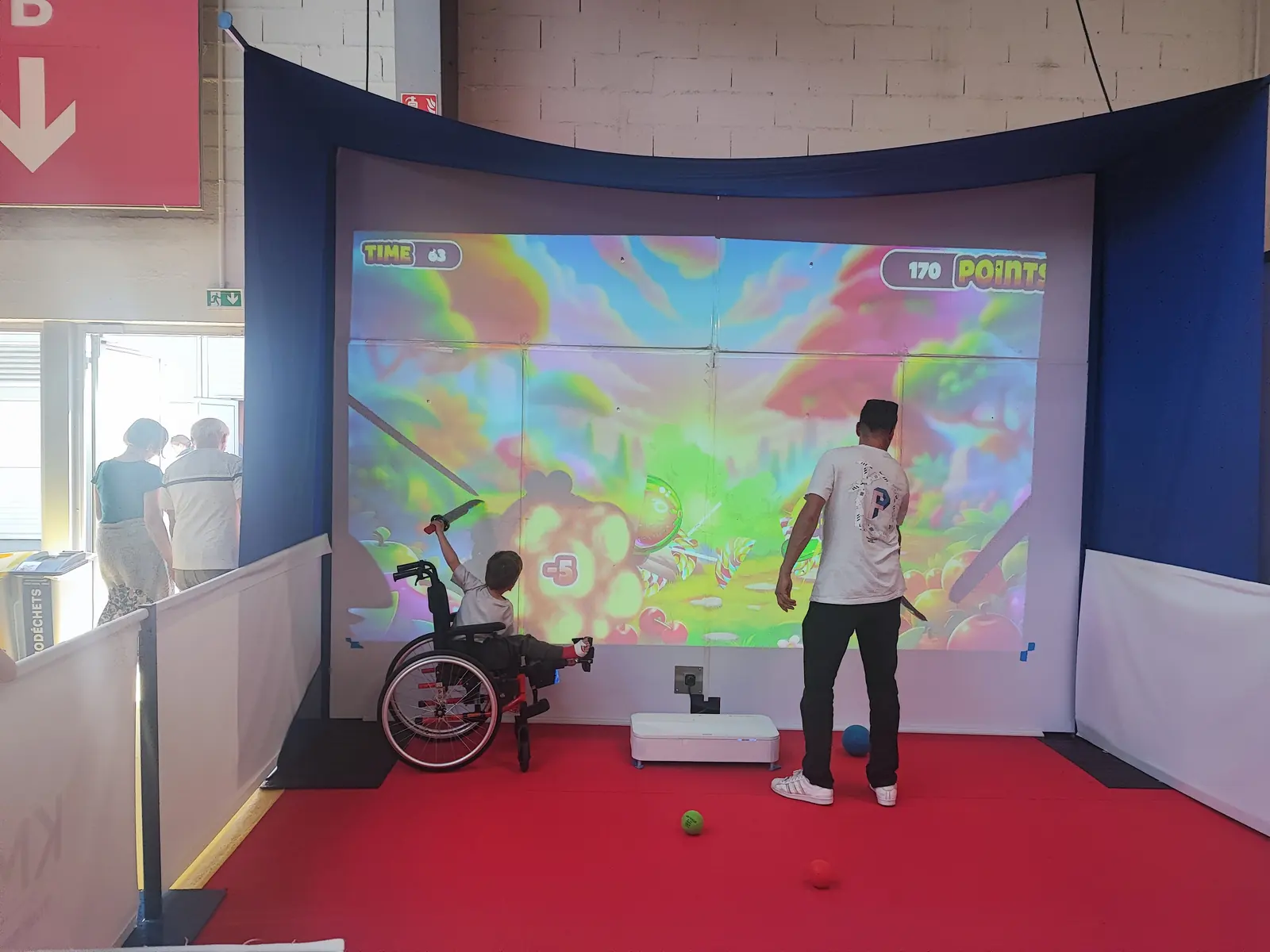
For an autistic child or adult, an interactive wall is a movement activity where cause and effect are visible: one gesture, and the target responds. Teams in specialized schools, early intervention services, residential programs and special education classrooms use it to work on motor skills, joint attention, turn-taking and tolerance of the group.
Poorly chosen equipment can do the opposite: too much noise, too many elements on screen, early-childhood visuals in front of an adult, a routine disrupted by every new feature. The criteria below separate a useful tool from a gadget, whoever the manufacturer.
For everyday use, two other articles complement this one: motor activities for autistic children and activities for autistic adults.
Criterion 1: can you adjust sound, speed and on-screen density?
Sensory hypersensitivity is common in autism. A suitable wall must let you mute sound entirely, slow the game down, reduce the number of elements on screen and enlarge targets, before the session and without complicated handling.
On Kmoove, every setting is adjusted before the game starts, and the projected surface ranges from two to four meters. During a demonstration, ask to see these menus for real: how many clicks does it take to make a game silent? A busy professional should manage it in seconds, without a manual.
Criterion 2: does the library suit every age and every profile?
Profiles vary widely: children and adults, people who speak and others who communicate differently, very strong special interests. A small library forces everyone onto the same games, and an adult ends up in front of preschool visuals.
Kmoove has one of the largest interactive wall libraries: 180 games, 150 of them customizable, in 2D and 3D, across every theme. The same games are used in schools, nursing homes and training, so you can pick visual worlds that suit adults. 2D games, visually simpler, work well for first sessions; 3D games add depth once the person has found their footing.
Criterion 3: can you add picture symbols and special interests?
Teams rely on visual supports people already know: picture symbols, photos of familiar places, everyday objects. A game that uses these images is understood faster, and a game about the person's passion, dinosaurs, the weather, flags, holds their attention far longer.
With Editor mode on E versions, you create your own content in under two minutes, with your own images, photos and videos. A sorting game can use the classroom's picture symbols, and a quiz can use photos from the week's outing.
Criterion 4: does the system respect routines?
Many autistic people need a session to start the same way every time. Check that a software update does not change familiar games on its own, and that the team stays in control of the order of activities.
For a dedicated room or a sensory room, the K-Station E is mounted on the wall. For a team working across several sites, such as an outreach service, the K-Mobile E sets up in five minutes, with no tools, and offers the same activity from one place to the next.
Criterion 5: does the detection film participants?
Some autistic people find it hard to be watched, and a camera pointed at them can be enough to make them leave the activity. In its standard configuration, Kmoove detects gestures with a laser sensor that captures no image, and no personal data is collected.
The K-motion camera option remains available for full-body games, useful for those who cannot hold a ball. More than 40 motion capture games are on the way for this option. The facility decides whether to add it.
Criterion 6: can people move from solo play to group play?
Turn-taking and tolerance of the group are often part of the individual support plan. A good wall lets people start alone, then in pairs, then in a small group, at their own pace.
Five players can play simultaneously on the Kmoove wall, and sixteen in relay on the same game. The turn order becomes visible on screen, which helps those for whom waiting is hard.
What questions should you ask the supplier before buying?
A short specification is enough. These questions, asked during the demonstration or in writing, let you compare several offers on the same basis.
- How many apps can be used on delivery, and which ones work without a subscription?
- Can full silence, speed and target size be set game by game?
- Can you import your own photos, picture symbols and videos, and how long does it take?
- Does the standard detection record images of participants?
- Does the equipment work without an internet connection?
- What warranty, what response time, what onboarding for the team?
- Can you arrange an on-site trial with the people you support?
Criteria 7 and 8: who runs it, and at what cost?
The wall must be easy for the existing team to run: educators, teachers, therapy professionals, adapted physical activity instructors. No IT skills are required, and no Wi-Fi connection is needed to play. The results of each game appear on screen, ready to feed into team reports.
On the budget side, thirty games come free for life with the hardware, with no subscription, which simplifies funding applications. The wall starts from €5,990 excluding VAT for the K-Station S, 3-year warranty included.
Why does the Kmoove interactive wall suit autistic people?
Designed and assembled in France, awarded best inclusive product at the Salon des Maires 2025, the Kmoove wall was built for the audiences that standard equipment leaves out.
- Sound, speed, number of elements and target size adjustable before each game.
- 180 games in 2D and 3D, with visual worlds suited to children and adults alike.
- Editor mode to add picture symbols, photos and special interests.
- Laser detection that never films, with the K-motion camera only as an option.
- A fixed wall for consistency, a mobile wall for teams on the move.
- Five simultaneous players and sixteen in relay, to practice turn-taking.
- Thirty games free for life, with no subscription.
What next?
The interactive wall is not a medical device: it complements educational and therapeutic work, it does not replace it. The autism and disability page covers uses in the sector, and the education page covers schools and special education classrooms. Tell us about the people you support: we get back to you within 48 business hours.
Featured models
Ready to see the interactive wall in your facility?
Request a quote and we will get back to you within 48 hours with configuration and pricing.