Buying guide · November 16, 2026 · 8 min read
What is the best interactive wall? How to choose one in 2026
There is no best interactive wall in absolute terms: there is the one that fits your audiences, your spaces and your budget. Here is a six-step method to compare offers, whoever the manufacturer.
What is an interactive wall?
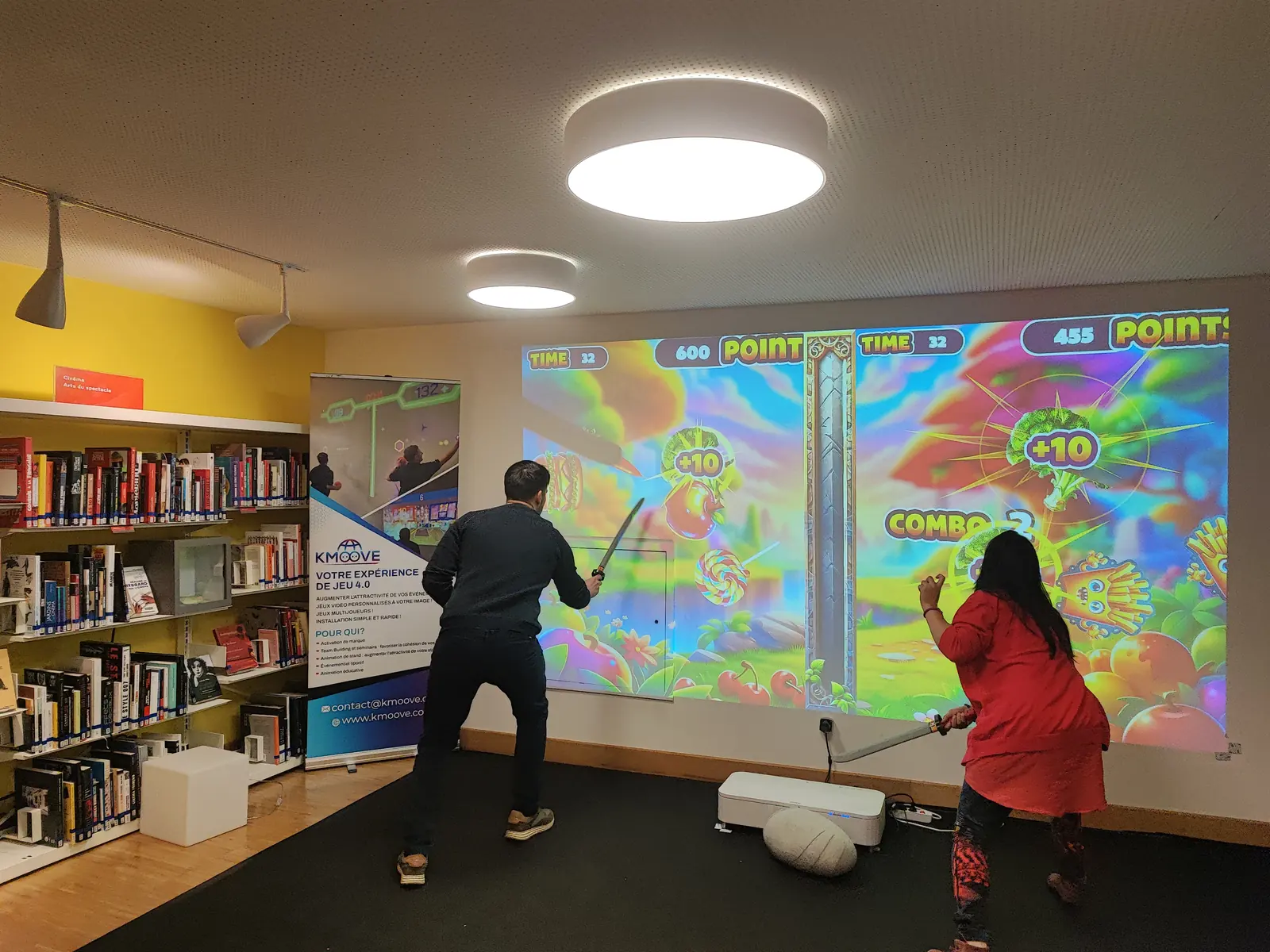
It is a projector paired with a sensor: the image, projected onto a wall, reacts when you touch it or throw a ball at it. Nothing to wear, no headset and no controller, and several people in front of the same surface.
The question "which one is best?" deserves an honest answer: it depends on who will play, where, and how many times a week. An elementary school, a public library, a campground and a residential care home do not expect the same thing. The method below starts from your needs, not from a spec sheet.
Step 1: who will play, and what for?
List your audiences before looking at the hardware. Each audience weighs on a different criterion.
Note the expected pace as well: one session a week, daily open access, or a few highlights during the year, such as a school fair, a neighborhood party or an open house. That pace determines how large a catalog you need and whether a fixed or a mobile model fits better.
- Schoolchildren: math, reading, foreign languages, motor skills in preschool.
- Older adults: gentle mobility, memory, social connection.
- Autistic people or people with disabilities: sensory settings, routines, visual supports.
- General public, families, vacationers: quick games, scores, friendly competition.
- Employees, trainees, apprentices: training quizzes, team challenges, corporate retreats.
Step 2: will the game library last for several years?
A device with only a couple dozen games uses up its novelty within a quarter. Check the quantity, but also the variety of themes and how often new games arrive.
Kmoove offers one of the largest interactive wall libraries: 180 games, 150 of them customizable, in 2D and 3D, across every theme (education, senior care, autism and disability, sports, leisure, events, training), on two systems, fixed or mobile.
2D games, easier to read, serve as an entry point; 3D games bring depth and stakes for experienced players.
Step 3: can you build your own activities?
This week's Spanish vocabulary, a reading challenge, a workshop's safety rules, your town's heritage: a homemade activity speaks louder than a generic game.
On Kmoove E versions, Editor mode handles it. Create your own content in under two minutes: add your own images, photos and videos for educational, teaching or recreational activities. Everything is prepared on a computer, then shows up on the wall at the next session.
Step 4: one room, or several locations?
A dedicated room open every day justifies a permanently installed model, such as the K-Station S. A gym on Monday, a covered playground on Tuesday, a library on Saturday: then you need a model on wheels, such as the K-Mobile E, with its projector built in.
Setup takes five minutes for the mobile model; the fixed model needs thirty minutes of mounting, done once. You need a light-colored wall and a power outlet, with no Wi-Fi network. The article fixed or mobile takes the comparison further.
Step 5: does the device capture images?
Schools, youth programs and disability services all ask this question, and the answer often shapes the purchase.
By default, Kmoove detects impacts with a laser, with no image capture at all. No personal data is sent anywhere: scores stay on the device, under a first name or a nickname. The K-motion camera, sold as an option, tracks the whole body to play without a ball; the buyer decides whether to add it.
More than 40 motion capture games are on the way for this camera.
Step 6: what budget over the whole lifespan?
Add up the purchase, the content and the maintenance over five years. A cheap model with a mandatory fee sometimes ends up costing more, and grants rarely cover that kind of recurring expense.
At Kmoove, thirty games free for life with the hardware, with no subscription. A subscription remains a choice, as does buying games one at a time. Entry price: from €5,990 excluding VAT for the K-Station S, with a 3-year warranty extendable to 5, and part of the range is listed with UGAP, France's public purchasing agency. Funding options: cost and funding.
A grid to score each proposal
Give zero to three points per line, for each supplier you consult, then compare the totals. The line that matters most depends on step 1.
- Number and variety of games available on delivery.
- Ability to create homemade activities, and the time it takes.
- Fixed version, mobile version, or both.
- No camera in the base configuration.
- Simultaneous players: Kmoove handles five, and sixteen in relay.
- Accessibility settings: speed, target size, sound, seated play.
- Total cost over five years, with or without a subscription.
- Free on-site trial, with the future users.
Going further for your audience
Two guides cover the criteria specific to one audience: equipping a nursing home and supporting autistic people. The schools, senior care and disability pages show concrete uses.
What Kmoove offers
Made and assembled in France, awarded best inclusive product at the Salon des Maires 2025, the Kmoove wall checks every line of the grid.
- Game library: 180 games, in 2D and 3D.
- Editor mode for homemade activities.
- Mobile model ready in five minutes, fixed model installed in thirty.
- Laser with no image capture, camera only as an option.
- Thirty games free for life, with no mandatory subscription.
Next step
Send us a description of your spaces and your audiences: we reply within 48 business hours with a priced configuration. An on-site demonstration then lets you fill in the grid with your own team.
Related sectors
Featured models
Ready to see the interactive wall in your facility?
Request a quote and we will get back to you within 48 hours with configuration and pricing.