Prevention and health · July 2, 2026 · 5 min read
Local government and health prevention: a different way to engage
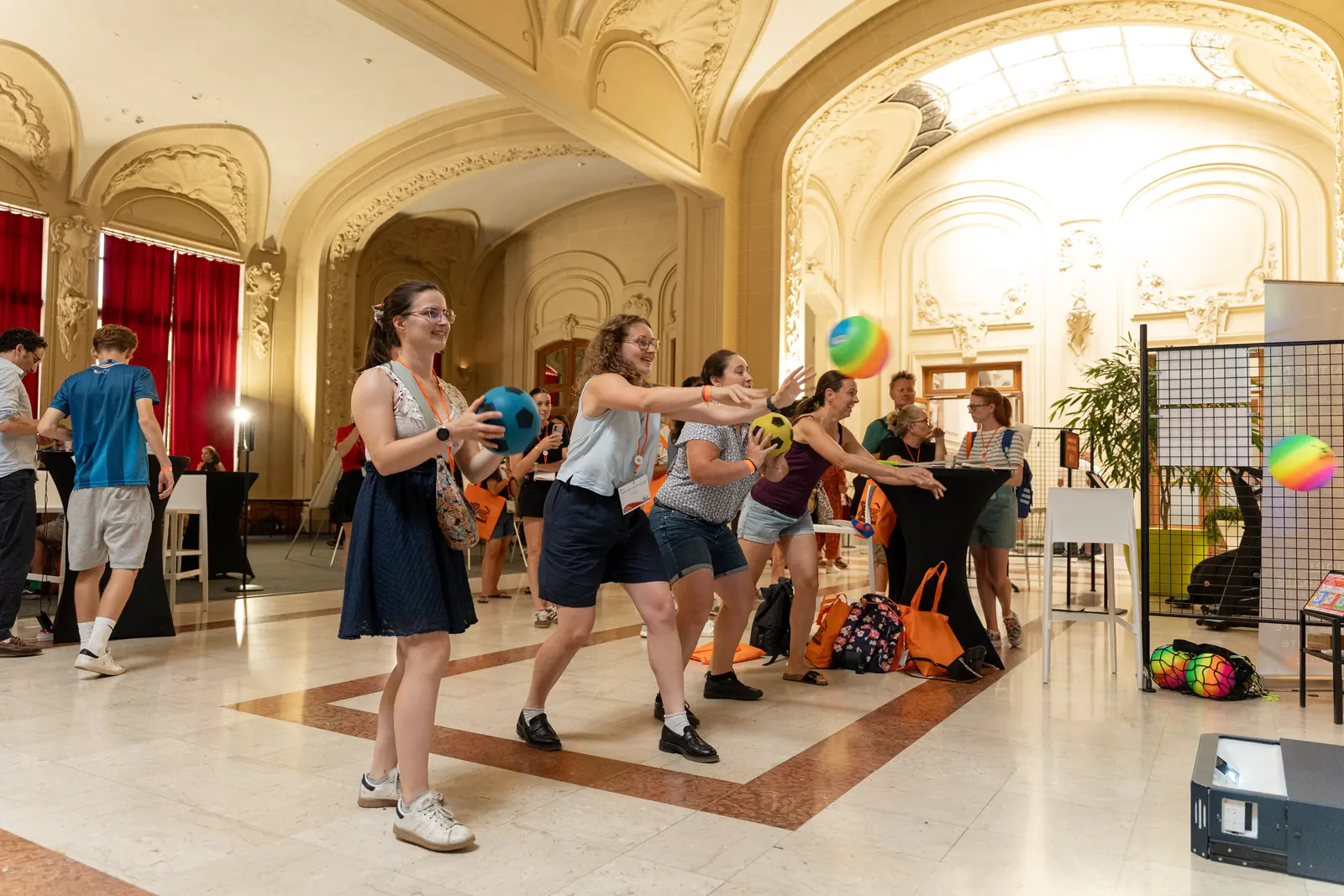
A prevention stand draws a crowd when it becomes a game. The interactive wall turns a public health message into a group activity, indoors or at an outdoor event.
The message travels through the gesture
Prevention campaigns often struggle to hold attention. On an interactive wall, the content becomes a game: moving quizzes, sorting games, dexterity challenges. The audience takes part first and remembers afterwards, while the activity leader keeps the useful talking time.
A system that travels across the local area
A local authority rarely uses a single venue. The K-Mobile moves from a school to a community center, from an association fair to a sport and health center, with the same setup every time. The system serves audiences of every age within the same week.
- Fairs, health awareness weeks, neighborhood events
- Regular workshops at a community or neighborhood center
- Content that can be personalized with the local authority's own branding
Public procurement
Kmoove is listed with UGAP, France's public purchasing agency, which simplifies procurement for local authorities and public institutions. We support teams in scoping the need and building the purchasing file.
Where a local authority uses it
The same system serves several departments, which is what usually justifies the purchase. Schools use it for movement and learning, youth centers for after-school activity, social services for older residents, sports facilities for adapted sessions, and public health teams for prevention events.
That range matters because a single-purpose piece of equipment is hard to fund from one budget line. A system shared between schools, care settings and community centers spreads its cost across services that rarely buy equipment together.
Prevention events are where it draws the largest crowds. A stand where people take part instead of collecting a leaflet holds attention long enough for a conversation about falls, activity or diet to actually happen.
Sharing one system across several sites
The K-Mobile travels between sites in a single eighteen-kilogram (forty-pound) case and sets up in five minutes with no tools. One authority can run a rotation between a school, a community center and a residential home without any site needing its own equipment.
No network is required at any of those sites, which removes the most common obstacle to shared equipment: every venue would otherwise need its own access arrangements.
Where one venue uses the wall every week, a permanently installed K-Station usually makes more sense, and the mobile unit continues to serve the rotation.
Funding and procurement routes
Kmoove is listed with the French public purchasing body UGAP, which allows direct purchase without running a tender. For authorities outside that framework, the usual routes are the prevention budget, the sports and youth budget, or a shared investment between departments.
The entry price is €5,990 excluding VAT, and the twenty built-in games carry no subscription. That absence of an obligatory running cost is the point funders examine most closely, because it means the investment does not create a charge in the following years.
The pricing page sets out the six configurations and what makes a quote vary.
Showing impact without collecting health data
Kmoove records no health data. Results stay local to the unit, and only a first name may be entered. An authority therefore cannot use the wall to build a health dataset, and this is deliberate.
What can be reported is attendance and reach: how many people took part, across which sites, in which age groups, at which events. Those are the figures a prevention program is usually asked for, and they are collected by the team rather than by the equipment.
For the full range of public sector uses, see the local government page and the prevention and public health page.
Can one system serve several sites?
That is the usual arrangement. The K-Mobile travels in a single eighteen-kilogram (forty-pound) case and sets up in five minutes with no tools, so one authority runs a rotation between a school, a community center and a residential home. Because no site needs a network, no site needs its own access arrangements either.
How do authorities fund it?
Most often by sharing the cost between services that rarely buy equipment together: prevention, sport, youth and social care. The entry price is €5,990 excluding VAT, and the twenty built-in games carry no subscription. That absence of an obligatory running cost is what makes a shared purchase defensible across several budget lines.
In France, Kmoove is listed with the public purchasing body UGAP, which allows direct purchase without running a tender.
Does it collect personal data about participants?
No health data at all. Results stay local to the unit and only a first name may be entered. Detection uses a laser sensor as standard, which captures no image. An authority therefore cannot build a health dataset from it, and that is deliberate.
What can be reported is reach: how many people took part, at which sites, at which events. Those figures are collected by the team, not by the equipment.
How many people can take part at a public event?
Five play at once and sixteen take part in the same game by taking turns, with no limit on the number of impacts detected at the same time. At a prevention event, that turnover is what holds a crowd: people take part rather than collect a leaflet, which is long enough for a conversation about falls, activity or diet to actually happen.
Related sectors
Featured models
Ready to see the interactive wall in your facility?
Request a quote and we will get back to you within 48 hours with configuration and pricing.