
Healthcare and disability services · September 9, 2026 · 7 min read
Nursing home activity ideas that actually get residents moving
Activities directors run out of ideas long before they run out of weeks. Here are approaches that hold a mixed group, including four that cost nothing, and what changes when the activity asks residents to stand up.
Why the same residents attend everything
Every community has a core group of eight or ten residents who come to everything, and a much larger group who never come. The second group is not less interested. They are usually the ones for whom the activity is either too hard, too slow, or too obviously an activity for old people.
Any idea worth adding to the calendar has to reach the second group. That means it has to work for someone independent and someone disoriented at the same time, and it has to look like something a person would choose rather than something arranged for them.
Four ideas that need no equipment
Reminiscence by object. Bring in five objects from the era residents grew up in and let the conversation go wherever it goes. Do not prepare questions; the objects do the work.
Seated relay with a light ball. Two rows facing each other, one ball, and a count. It is trivially simple and it produces more laughter than most planned activities.
The local newspaper, read aloud, with the property pages and the obituaries left out. Residents interrupt constantly, which is the point.
A cooking smell without cooking. Warming spices or citrus peel in the activity room changes the atmosphere of a session before it starts, and it reaches residents who no longer follow speech.
What changes when residents stand up
Most activities in senior living happen sitting down, and that is a real problem: sitting all day is one of the fastest routes to losing independence. But asking residents to exercise rarely fills a room.
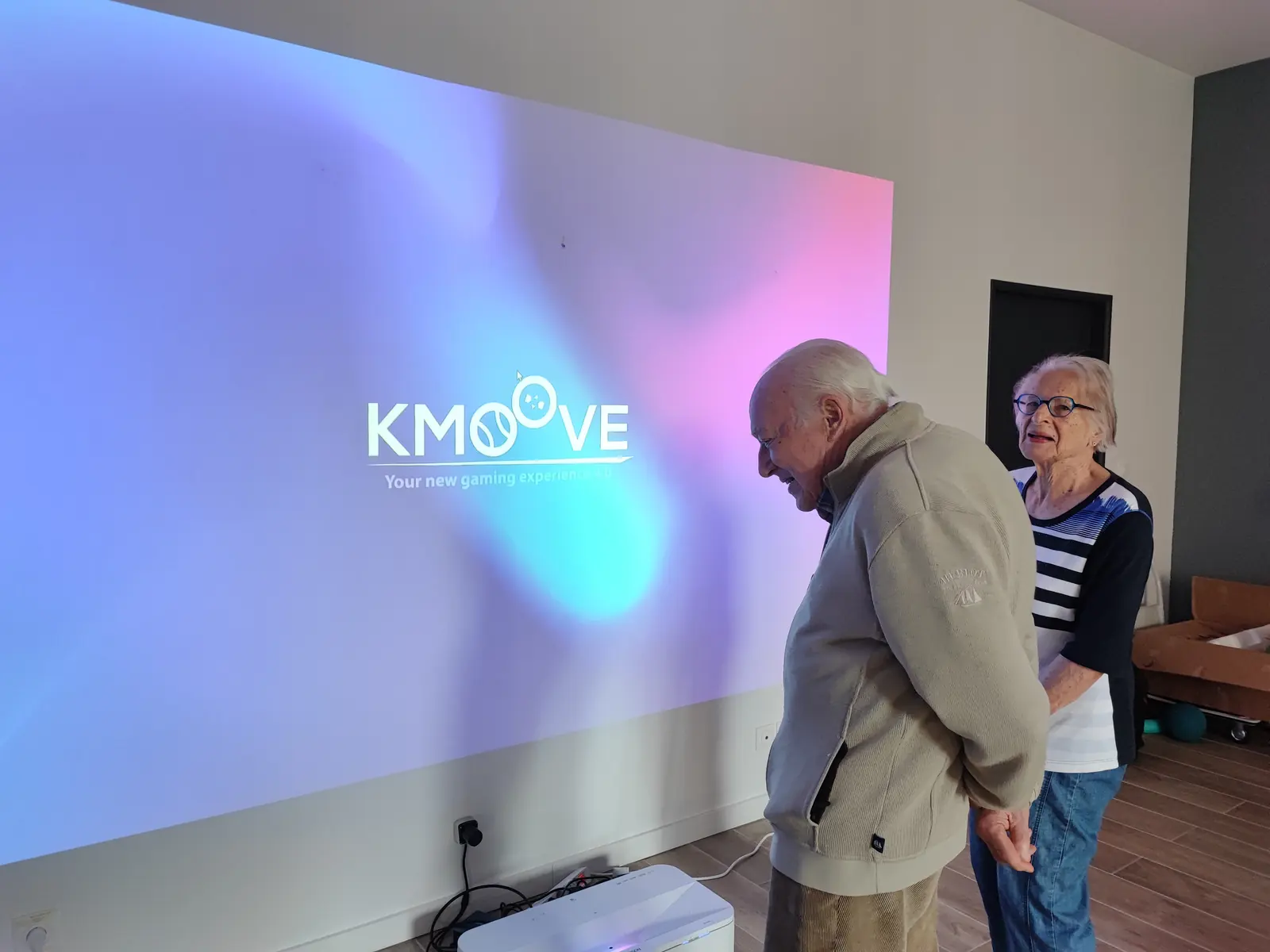
An activity that requires standing without announcing itself as exercise solves both. On an interactive wall, residents throw a soft ball or touch a target on a projected image two to four meters (roughly 7 to 13 feet) wide. They stand, reach, step sideways and turn, because the game asks for it and not because a program does.
Five residents play at once and sixteen take part by taking turns, which fits the size of a normal activity group. Residents waiting their turn watch and encourage, which is participation rather than waiting.
How do you include residents with dementia?
Short rounds of two to three minutes, one instruction at a time, and content built from familiar images. In memory care, the activity that works is almost never the most sophisticated one.
Editor mode lets a team build activities with photographs of the community, of the local town or of the staff themselves. A matching game made with the faces of the care team reaches residents that generic content does not, and it takes an afternoon to build.
Ending while engagement is still high matters more than length. A session stopped at twenty minutes with residents still enjoying it produces a resident who asks for the next one.
How do you build a calendar you can actually sustain?
Use slots that already exist rather than adding new ones. A Tuesday afternoon memory workshop, a Thursday movement session, a Friday social hour: change what happens inside them rather than adding a fourth appointment to a schedule nobody can staff.
Preparation time decides everything. Anything that takes more than five minutes to set up gets used at open days and forgotten in between. A K-Station stays installed; a K-Mobile sets up in five minutes with no tools and travels between floors or to a memory care unit rather than bringing residents downstairs.
See the senior living and nursing homes page for how communities structure this across a week.
How do you reach residents who never come to anything?
Bring the activity to them rather than inviting them to it. A K-Mobile set up in a corridor or a lounge catches residents passing by, and passing by is how most reluctant residents first take part.
The second approach is to make joining cost nothing. A resident who can watch for ten minutes and then throw one ball has joined; a resident who must sign up, come downstairs and sit in a circle has not.
What does it cost to add this to the calendar?
From €5,990 excluding VAT, with twenty activities built in that work for life with no subscription. There is no recurring charge, which is the point administrators check first. The pricing page sets out the configurations, and the frequently asked questions cover the points activities directors raise most often.
Related sectors
Featured models
Ready to see the interactive wall in your facility?
Request a quote and we will get back to you within 48 hours with configuration and pricing.